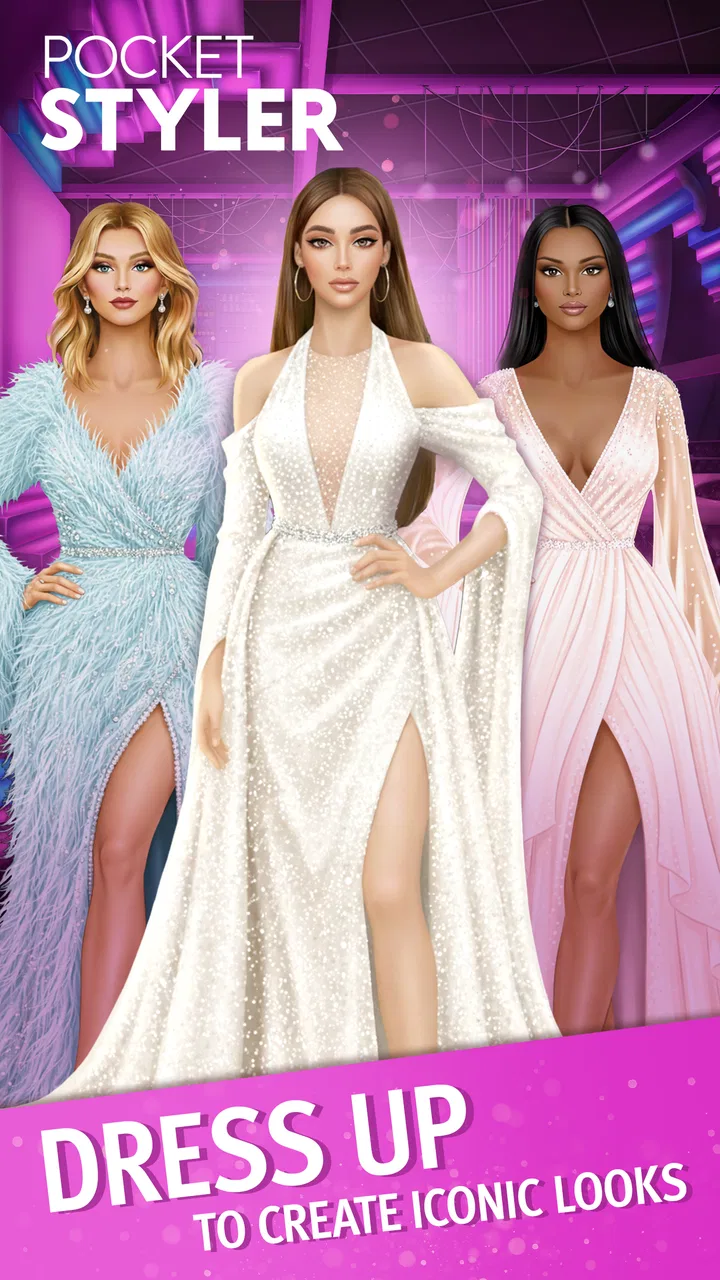
Pocket Styler: Dress Up Game
- 3.8
- Rating
- 10.00M
- Installs
- Free
- Price

 Analysis by App-foxy
I expected Pocket Styler: Dress Up Game to be a quick outfit-matching distraction, but its strongest idea is more focused than that: it turns styling into a series of visual decisions. I choose clothes, makeup, hair, and accessories, then judge whether the complete look feels suitable for the scene. That small shift matters. Instead of simply collecting attractive items, I have to think about coordination, mood, and how much attention each part of an outfit deserves.
That makes this a casual fashion game rather than a serious design tool. It is free to start, suitable for Everyone, and developed by Nordcurrent Games. The game has reached over ten million installs, so it clearly appeals to people who enjoy short, appearance-focused challenges. My experience is that it works best when I treat each styling task as a creative puzzle, not as a competition I must solve perfectly.
The central question is simple: do you want a relaxed dress-up game where presentation is the main activity, or are you looking for deep customization, simulation, or a realistic fashion-planning assistant? If you want the first option, this is easy to pick up. If you want the second, its limits become noticeable fairly quickly.
You May Also Like

 Blood Strike: 2.5 Anniversary
Blood Strike’s Loadouts Turn Every Drop Into a Tactical Gamble
A close look at Blood Strike’s custom loadouts: how fast access to signature weapons reshapes its battle royale rhythm, rewards preparation, and narrows the gap between fights.

 Pandora - Music & Podcasts
Pandora’s Music Is Easy to Start, but Harder to Recover
Pandora’s strength is its low-effort path from a seed to a station. Its weak spot is how much confidence it asks you to place in connection, setup, and quiet recovery.

 8 Ball Pool
 Is Built on Rivalries, Rematches, and Routine
A close look at the rivalries, rematches, shared routines, and unanswered safety questions that turn a quick pool match into a persistent mobile community.

 Samsung Music
’s Quiet Strength Is Playing What You Already Own
Its reach comes less from spectacle than from dependable access to a personal library. That simplicity is both the app’s strongest retention engine and its ceiling.

 AccuWeather: Weather Radar
AccuWeather Review: A Quick, Clear Forecast for Everyday Decisions
For everyday plans, the best forecast is the one you can understand quickly. AccuWeather makes rain timing, radar, and local conditions easy to act on, with a few trade-offs.

 Hill Climb Racing
Why Hill Climb Racing Still Turns Crashes Into One More Run
A tiny car, a bumpy hill and one more upgrade: Hill Climb Racing keeps resurfacing because its simple chaos makes every near-miss feel personal.
More From Our News Desk
View All News


Why the styling challenge is the real hook
I find that the challenge works best when I treat each look as a small design problem, not a hunt for the flashiest item. This section looks at how setting a visual intention can make the choices feel more rewarding, while also clarifying why the game may not satisfy someone who wants unrestricted character creation. The same deliberate approach carries into the practical styling routine that follows.
More than choosing the prettiest item
The most interesting capability here is the complete-look approach. A dress may be attractive by itself, but it can lose impact if the makeup, hair, shoes, or accessories pull the outfit in another direction. I found myself making choices in layers: first deciding the general mood, then selecting the main garment, and only afterward adding details that support rather than compete with it.
This gives the game a useful rhythm. I am not merely tapping through a wardrobe until something looks expensive or dramatic. I am building a visual answer to a prompt. Even when the available choices are limited, the order in which I make decisions changes the result. Starting with a strong central piece usually gives me a clearer direction than beginning with jewelry or makeup.
That is also where the game feels different from a basic avatar dress-up app. In a simple wardrobe toy, the goal is often personal expression with no real pressure to make the pieces work together. Here, I pay more attention to balance. A bold outfit may need simpler styling around it, while a plain base can benefit from a stronger accessory or more noticeable makeup.
Makeup and accessories are not just decoration
The makeup element has a practical effect on how I read the finished look. It can reinforce a polished outfit, soften a dramatic one, or make a combination feel mismatched if I choose it without considering the clothes. The same is true of accessories. They are useful for giving an outfit a final point of focus, but adding too many attention-grabbing details can make the result feel scattered.
My most reliable method was to pause before making the final additions. I would look at the outfit as a whole and ask what it was missing: contrast, a cleaner finish, a stronger focal point, or simply less clutter. That extra moment is more valuable than repeatedly changing individual items at random.
The best results usually come from restraint, not from filling every available styling choice. That is a small lesson, but it is the kind of lesson that gives this casual game more staying power than a purely decorative dress-up screen.
A visual game for short decisions
The game suits people who like making quick creative choices without having to learn complicated controls. I can open it for a brief session, complete a styling task, and leave without needing to remember a complex strategy. The fashion theme provides enough variety in the decisions to keep those short sessions from feeling identical, particularly when I approach each look with a different intention.
At the same time, this is not a replacement for a fashion design application. I am not sketching garments, adjusting patterns, or planning real outfits from my own closet. The appeal is the immediate visual feedback of putting a look together inside a game. That distinction is important because someone searching for practical wardrobe advice may find the experience entertaining but not especially useful outside the game.
How I use the styling flow in practice
A little structure makes each styling session feel less like random tapping: I settle on the outfit’s mood, build around the main clothing choice, and save details for last. Here I’ll focus on how that sequence helps me compare options without getting bogged down, and when reversing it can be useful for experimentation. Those habits also help reveal whether the game’s repeated challenges suit the way a player likes to spend short breaks.
Start with the occasion, then build outward
When I rush, I tend to choose the first attractive item and force everything else to fit around it. That approach can work, but it often produces a look that is attractive in separate pieces and unconvincing as a whole. I get better results by deciding what the outfit is supposed to communicate before selecting the finishing details.
I usually begin with the main clothing choice because it establishes the strongest visual signal. From there, I choose hair and makeup that agree with its tone. Accessories come last. This workflow reduces unnecessary switching and helps me notice when a detail is improving the outfit rather than merely making the screen busier.
There is a useful exception: if the clothing options feel ordinary, I sometimes begin with a distinctive accessory or makeup direction and let that guide the rest. This is a good way to avoid producing the same safe combination every time. The trade-off is that the final outfit can become harder to balance, so I use this approach when I want experimentation rather than the most dependable result.
Use contrast deliberately
One of the more effective techniques I discovered is controlled contrast. I do not mean choosing unrelated pieces simply because they are different. I mean allowing one part of the look to stand out while keeping the surrounding choices quieter. A strong central item becomes easier to appreciate when the supporting elements do not all compete for attention.
This is especially helpful when I am unsure why a look feels messy. Instead of replacing everything, I remove or simplify one distracting element. That often improves the result faster than searching through every available option. It also makes the process less tiring, which matters in a game designed around repeated styling decisions.
Review the silhouette before the small details
Another practical habit is to judge the overall shape before worrying about tiny finishing touches. I first look at the character from a distance and consider whether the outfit has a clear visual identity. Only then do I spend time on accessories and makeup. This prevents me from polishing a combination whose main clothing choices never worked together.
That workflow is particularly useful for players who feel overwhelmed by choice. It creates a simple hierarchy: overall direction first, supporting pieces second, decoration last. The game remains casual, but this order gives the activity a little more structure and makes experimentation feel intentional.
What the rating tells me, and what it does not
The game currently sits at a 3.8 average from around 118 thousand ratings, with roughly 5.5 thousand written reviews. I read that as a sign of a broad but mixed reception rather than a universal recommendation. The large audience suggests that the basic dress-up loop is accessible, while the middling score reminds me that fashion games can be very dependent on personal expectations.
Someone who enjoys visual challenges and gradual outfit experimentation may find the experience satisfying. Someone who dislikes repeated presentation tasks, wants complete freedom immediately, or expects every item to be available without friction may be less impressed. The rating makes sense to me because the core idea is appealing, but the enjoyment depends heavily on how much value I place on styling variations.
A realistic everyday session
Imagine having ten minutes while waiting for an appointment. I can open the game, choose a styling task, and work through the look without needing a long uninterrupted session. I might first select the main outfit, then try two different makeup directions, compare the overall balance, and finish with only one or two accessories. The point is not to create a real outfit for later; it is to enjoy a compact creative activity with a clear visual ending.
For that use, the game is more convenient than a larger fashion simulation. I do not need to manage a long story or learn a complicated system before reaching the enjoyable part. However, if I am looking for something that rewards a long evening of strategic play, this may feel lightweight. Its strength is the short styling decision, not a demanding campaign.
Free entry, but spending changes the experience
The game is free to download and play, with in-app purchases ranging from under a dollar to as much as $120 for an individual item. That range is worth considering before starting, particularly if the visual collection aspect is likely to tempt you. I can approach the game without paying, but the presence of optional purchases means I need to be comfortable enjoying the available styling process without treating every desirable item as essential.
My advice is to decide on a personal spending boundary before getting invested in collecting. Fashion games can make a new garment feel like the missing piece in a look, even when the real challenge is improving the combination of items already available. If I focus on coordination rather than ownership, the free starting point feels more manageable.
This is also where the game differs from a conventional dress-up application with a fixed wardrobe. A fixed wardrobe offers predictability: I know exactly what I have and can experiment without purchase prompts. Pocket Styler has a more ongoing structure around fashion choices, which can feel more rewarding for players who enjoy discovering new possibilities but less comfortable for players who want a completely open creative sandbox.
Where it can become repetitive
The same styling loop that makes the game accessible can also limit its longevity. Selecting clothes, applying makeup, and refining accessories is pleasant when I am in the mood for visual experimentation. After several similar sessions, though, I may want a stronger change of pace than another outfit decision provides.
I also noticed that the game is best enjoyed when I set my own small goals. For example, I might try to create a restrained look, use one standout detail, or build an outfit around a particular mood. Without that personal challenge, the activity can become a sequence of taps rather than a creative exercise.
Players who need direct control over every visual aspect should keep their expectations realistic. The game gives me a curated fashion experience, not the unlimited editing found in specialized character creators. That curation helps the interface stay approachable, but it also means my freedom is shaped by the choices the game presents.
Device and compatibility basics
The current version is 11.0.1 and it supports Android 7.0 or later. That makes it accessible on many older Android devices, although the practical experience can still depend on the phone’s performance and available storage. I would keep the game updated where possible, since a fashion title built around visual presentation benefits from receiving its current content and fixes.
Its Everyone age rating makes it suitable for a broad audience, but parents should still remember that the game includes optional purchases. The age rating describes who can use the game; it does not remove the need to supervise spending on a shared device.
Who gets the most from Pocket Styler
For me, the best fit is someone who enjoys fashion as a quick visual puzzle and is happy to work within the choices a game presents. This section weighs that appeal against the reasons a player might prefer a design tool, a practical wardrobe planner, or a more varied style of game. It also brings the progression question into focus: whether gradual goals and new styling possibilities are enough to keep the experience enjoyable over time.
Best for creative casual players
I would recommend this game to anyone who enjoys styling characters, comparing visual combinations, and making small creative decisions during spare moments. It is particularly suitable for players who like fashion as a form of self-expression but do not need realistic clothing rules or a detailed simulation. The accessible format lets me experiment without first learning a complicated control scheme.
It is also a good match for players who enjoy improving through observation. The most satisfying part for me is noticing why one combination feels more coherent than another, then applying that lesson to the next look. That makes the game a little more engaging than simply dressing a character according to personal taste.
Who should choose something else
I would skip it if my priority is practical outfit planning, garment creation, or a deep life-simulation experience. The game can inspire ideas about color balance and accessories, but it does not replace a closet organizer or a design program. I would also look elsewhere if I dislike optional purchases strongly enough that their presence makes the entire experience uncomfortable.
Players who prefer action, puzzles with clear right answers, or long-form storytelling may find the fashion loop too narrow. There is no reason to force a dress-up game into a role it was not designed to fill. Its value comes from the styling activity itself, and that is either appealing or uninteresting depending on the player.
My recommendation after using it
Pocket Styler: Dress Up Game works because it makes the complete look the challenge. I enjoy it most when I slow down enough to consider the relationship between the main outfit, makeup, hair, and accessories instead of treating each choice as an isolated reward. The game is easy to enter, comfortable for short sessions, and broad enough to attract a large casual audience.
Its weaknesses are just as clear: the loop can feel repetitive, freedom is shaped by the available choices, and optional purchases may affect how comfortable some players feel while collecting fashion items. Those are not minor details, but they do not erase the appeal of the core styling process.
If you want a quick fashion puzzle with room for visual experimentation, I think it is worth trying for free. I would approach it with a simple rule: judge each outfit by how well the pieces work together, not by how many items I can unlock or how elaborate I can make the final screen. With that mindset, Nordcurrent Games’ casual title becomes a pleasant creative break rather than a demanding fashion simulator, and that is where it delivers its best experience.
FAQs for Pocket Styler: Dress Up Game
01What is Pocket Styler: Dress Up Game?
Pocket Styler: Dress Up Game is a fashion-focused mobile game where you create outfits, style characters, and participate in themed challenges. You can combine clothing, shoes, hairstyles, makeup, and accessories to build complete looks, then submit them for judging. The game is aimed at players who enjoy dress-up gameplay, creative customization, and competing with other fashion enthusiasts.
02Is Pocket Styler: Dress Up Game free to download and play?
Pocket Styler can generally be downloaded for free on supported Android and iOS devices, allowing you to begin styling without paying upfront. However, the game includes optional in-app purchases for premium clothing, accessories, currency, or other advantages. Progress is possible without spending money, although some items and faster customization options may require patience or watching available advertisements.
03Does Pocket Styler require an internet connection?
An active internet connection is usually needed for the main Pocket Styler experience. Online access allows the game to load new fashion challenges, synchronize your progress, display community voting, and provide seasonal content. Because of these connected features, the game may not work fully offline. If you are traveling or using mobile data, it is worth checking your connection and data usage before playing.
04How does judging and competition work in Pocket Styler?
Pocket Styler challenges typically provide a theme, location, or style requirement, and you create an outfit that matches the brief using items from your wardrobe. Completed looks may be evaluated through votes or game-based scoring, depending on the event. Higher results can bring rewards and recognition, but success often depends on following the theme carefully, coordinating colors, and owning suitable fashion items.
05Is Pocket Styler suitable for children and younger players?
Pocket Styler is accessible and easy to understand, but parents should review the game’s age rating and privacy information before allowing younger children to play. The app may include in-app purchases, advertisements, online features, and interactions connected with a wider player community. To avoid accidental spending, parental controls and purchase restrictions should be enabled on the device.
Pros
- Large wardrobe with frequent new clothing and accessory drops.
- Easy to create themed looks for different fashion challenges.
- Voting system lets you compare outfits with other players.
- Works well for short sessions and quick daily challenges.
- Stylish visuals make outfit details easy to see on mobile screens.
Cons
- Energy limits can interrupt play when you want to enter more challenges.
- Premium items may require patience or real-money purchases to obtain.
- Some events favor players with extensive wardrobes and rare items.
- Repeated voting and challenge formats can feel predictable over time.
- An internet connection is generally needed for the full game experience.

Pocket Styler: Dress Up Game
Gallery